
Douglas Levermore | The Singapore Solution for sustainable economic frowth and development in small-island developing states

There is an old saying, commonly attributed to French historical figure Napoleon Bonaparte, that the policy of a state lies in its geography. If that were true, Singapore should never have been.
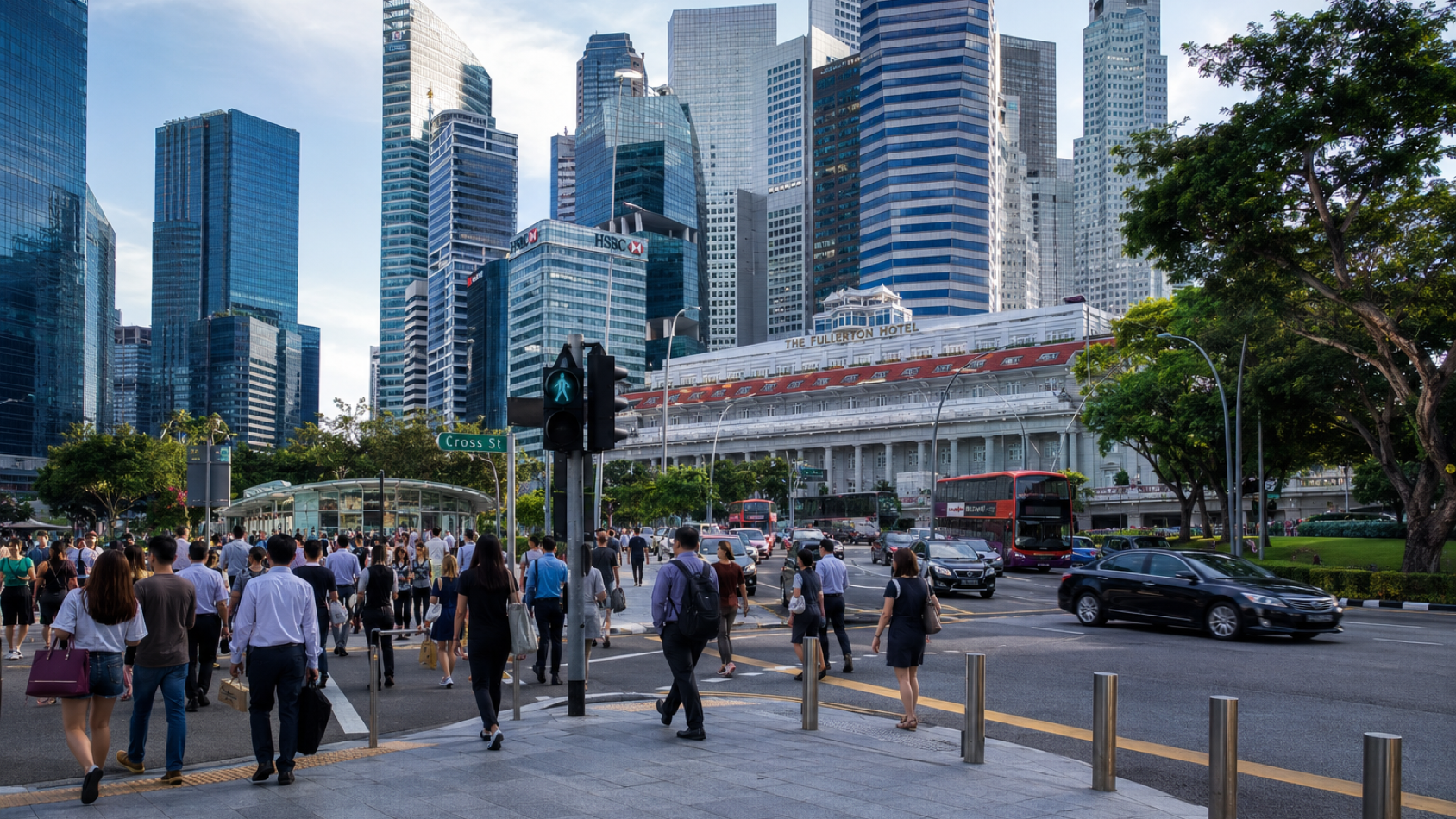
Located at the southern tip of the Malay Peninsula in Southeast Asia, Singapore occupies barely 735 square kilometres, making it smaller than many Caribbean parishes. It has virtually no natural resources, imports almost all of its energy and much of its food, and has even spent decades importing water from neighbouring Malaysia. Despite these apparent disadvantages, this tiny island nation has built one of the world’s most successful economies.
Today, Singapore’s economy generates a Gross Domestic Product (GDP) of more than US$560 billion, while its GDP per capita ranks among the highest globally. It consistently appears near the top of international rankings for competitiveness, logistics, education, governance, innovation, and ease of doing business. To many observers, Singapore’s transformation from a vulnerable newly independent nation in 1965 into one of the world’s premier financial and commercial centres appears almost miraculous.
But miracles rarely explain sustained economic success.
Singapore’s transformation was neither accidental nor anonymous. It was shaped principally by the vision and determination of its founding Prime Minister, Lee Kuan Yew, who led the country from 1959 to 1990, together with an exceptionally capable team that included Goh Keng Swee, S. Rajaratnam, Toh Chin Chye, and Hon Sui Sen. At independence in 1965, they inherited a small island with high unemployment, scarce natural resources, ethnic tensions, and an uncertain future after separation from Malaysia.
Rather than allowing those constraints to define the nation, they built a government that prized competence over patronage, long-term planning over short-term politics, and execution over rhetoric. While no leader builds a nation alone, Lee Kuan Yew’s disciplined, pragmatic and often uncompromising style of leadership established the culture of excellence that continues to shape Singapore more than half a century later.
Behind Singapore’s remarkable story lies something far more instructive than luck, geography or even culture. It is what this author refers to as the Singapore Solution: the deliberate alignment of five national priorities pursued consistently over decades, regardless of changing political personalities or shifting global economic conditions. Those priorities were straightforward but remarkably disciplined—invest in people, build strong institutions, embrace the global economy, think beyond election cycles, and cultivate trust. None of these ideas was revolutionary on its own. Their power came from leadership’s unwavering commitment to pursuing all five simultaneously for more than half a century.
That may be Singapore’s greatest lesson for developing countries. Sustainable economic growth is rarely the product of one brilliant policy, one charismatic leader, or one fortunate discovery of natural resources. It is usually the result of disciplined leadership making thousands of consistent decisions over many years, with each decision reinforcing the next.
That conclusion is supported by research. Professor Ricardo Hausmann of Harvard University’s Growth Lab and his colleagues have demonstrated through their work on the Economic Complexity Index (ECI) that countries become wealthier not because they possess abundant natural resources, but because they continuously accumulate productive knowledge, develop increasingly sophisticated capabilities, and diversify into more complex industries. In other words, prosperity is built deliberately. Singapore stands as perhaps the world’s clearest example of that principle.
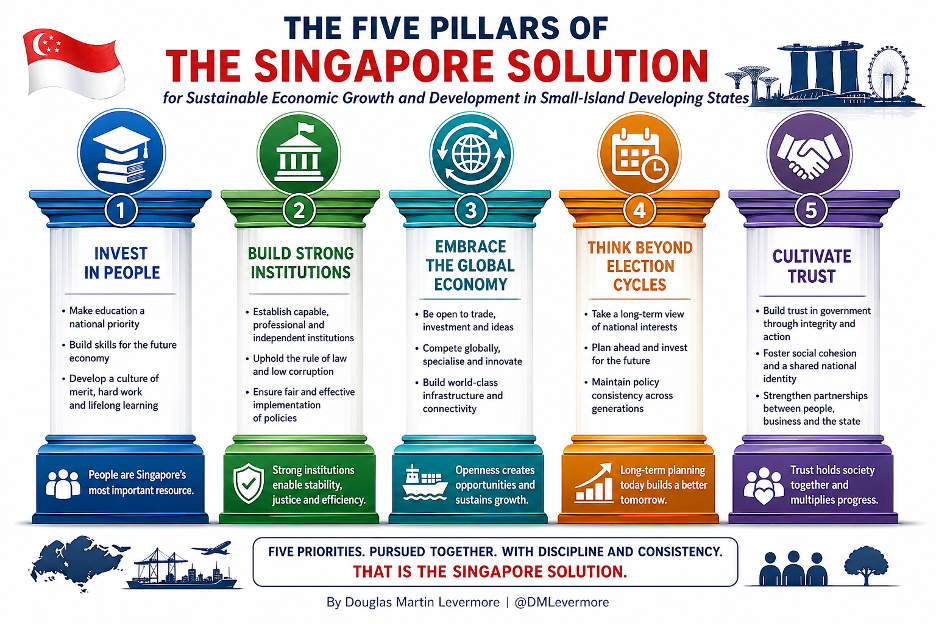
The first pillar of the Singapore Solution is recognising that people are the nation’s greatest natural resource —not petroleum, minerals, or fertile land. Since the country possessed few physical assets, its leaders concluded that the only sustainable competitive advantage would come from developing an exceptionally skilled workforce. Education therefore became far more than social policy; it became economic policy. Schools were designed around future labour market needs, technical and vocational education received the same respect as university education, and institutions of higher learning worked closely with industry to ensure graduates possessed skills that employers actually required. Long before lifelong learning became fashionable elsewhere, Singapore understood that continuous education would become essential in an economy constantly adapting to technological change.
That investment paid remarkable dividends. As the global economy evolved, Singapore successfully transitioned from labour-intensive manufacturing to electronics, pharmaceuticals, biotechnology, financial services, advanced manufacturing, logistics, digital technology, and artificial intelligence. Rather than fearing economic disruption, it prepared its workforce to lead it.
There is an important lesson here for Jamaica. For decades, Jamaica has produced world-class teachers, engineers, doctors, accountants, athletes, musicians, entrepreneurs and professionals who have excelled across the globe. Our problem has never been a shortage of talent. Rather, we have struggled to create sufficient opportunities for that talent to flourish at home. Too often, education policy operates independently from industrial policy. Universities produce graduates without a sufficiently clear understanding of where the economy intends to be ten or twenty years from now. Singapore demonstrated that workforce planning should begin not with today’s vacancies but with tomorrow’s industries. If Jamaica hopes to compete in emerging sectors such as artificial intelligence (AI), digital services, medical technology, renewable energy and advanced logistics, then today’s classrooms must begin preparing students for jobs that, in many cases, have yet to be created.

The second pillar of the Singapore Solution is building institutions before aggressively pursuing economic growth. Many developing countries spend enormous energy trying to attract investors while paying comparatively little attention to the institutions those investors eventually encounter. Singapore reversed that logic. Leadership understood that sustainable investment follows confidence, and confidence is created through capable institutions.
Over many years, Singapore invested heavily in building an efficient civil service, an impartial judiciary, competent planning agencies, effective regulators, modern infrastructure and a reputation for integrity. Investors came to believe that contracts would be honoured, regulations would be applied consistently, public officials would act professionally, and government policy would remain relatively predictable. That confidence dramatically reduced the uncertainty businesses normally associate with emerging markets.
The lesson for Jamaica extends well beyond attracting foreign direct investment. Investors can adapt to geography. They can accommodate higher labour costs, different tax structures and even relatively small domestic markets. What they find much more difficult to manage is uncertainty. Lengthy approval processes, inconsistent regulatory decisions, bureaucratic duplication and unpredictable implementation all increase business risk, and increased risk inevitably translates into higher costs. Strong institutions therefore become economic assets in their own right because they reduce the cost of doing business while increasing investor confidence.
This lesson resonates particularly strongly with those of us who have spent our careers working in Public Investment Management (PIM). Good institutions do not simply spend public money; they allocate scarce resources strategically, evaluate competing priorities objectively, monitor implementation rigorously, and continuously ask whether investments are producing the intended economic and social benefits. Countries rarely become prosperous because they spend more. They become prosperous because they spend better.
The third pillar of the Singapore Solution is an unwavering commitment to embracing the global economy rather than seeking shelter from it. Singapore’s leaders recognised from the outset that a nation of fewer than six million people could never rely solely on domestic consumption to achieve sustained economic growth. Instead of viewing its small size as a handicap, Singapore transformed it into a strategic advantage by positioning itself as one of the world’s most connected economies. Foreign direct investment was actively encouraged, an extensive network of trade agreements was negotiated, world-class ports and airports were developed, and multinational corporations were welcomed to establish regional headquarters. Every major policy reinforced the country’s ambition to become an indispensable gateway between Asia and the rest of the world.
Equally significant was Singapore’s decision to specialise rather than attempt to compete in every industry. Leadership understood that national competitiveness is rarely achieved by doing everything reasonably well. Instead, it is built by becoming exceptionally good at a handful of strategically important activities. Singapore concentrated on advanced manufacturing, financial services, maritime logistics, biotechnology, semiconductor production and, more recently, digital technologies and artificial intelligence. Each success strengthened the next, creating a virtuous cycle in which investment attracted talent, talent attracted innovation, and innovation attracted even more investment.
For Jamaica, the implications are difficult to ignore. Few countries occupy such a strategically advantageous location at the crossroads of the Americas, within close proximity to the world’s largest consumer market and along major international shipping routes. The Port of Kingston, Norman Manley International Airport, and Sangster International Airport already provide a solid foundation upon which a far more diversified economy could be built. Yet geography alone has never created prosperity. Geography merely presents opportunity. The real competitive advantage lies in how intelligently that opportunity is developed. The Singapore experience suggests that Jamaica’s future may depend less on attempting to compete in every sector and more on identifying those industries in which the country can become regionally or globally indispensable.
The fourth pillar is the discipline to think in decades rather than election cycles. This may well be the most difficult lesson for many democracies, where political incentives often encourage short-term achievements over long-term transformation. Singapore deliberately resisted that temptation. Housing policy complemented transportation planning. Education policy supported industrial development. Land use planning reinforced economic strategy. Infrastructure investments were selected not because they produced immediate political rewards but because they advanced clearly articulated national objectives.
The result was a remarkable degree of policy continuity. As industries evolved and technologies changed, the country’s long-term direction remained consistent. Roads were viewed not simply as transportation projects but as economic corridors. Ports became engines of international competitiveness. Schools became investments in the future workforce rather than merely places of instruction. Public investment became part of an integrated national strategy rather than a collection of unrelated capital projects.
For Jamaica, this lesson extends far beyond infrastructure. Sustainable development requires every major investment to support a broader national vision. Roads should facilitate industrial expansion. Housing developments should anticipate future employment centres. Broadband infrastructure should support digital transformation. Universities should prepare graduates for sectors identified in long-term development plans. When individual investments reinforce one another, their combined impact becomes far greater than the sum of their individual contributions.
This principle lies at the heart of effective PIM Systems. Countries with mature PIM systems understand that prosperity is not created simply by spending more public money. It is created by selecting the right projects, sequencing them appropriately, managing them effectively, and evaluating whether they actually deliver the anticipated economic and social benefits. Disciplined public investment creates a compounding effect in which every successful project enhances the value of those that follow.
The fifth pillar of the Singapore Solution is the deliberate cultivation of trust. While economists frequently discuss financial capital, physical capital and human capital, trust represents an equally valuable form of national capital. Businesses invested because they trusted that contracts would be honoured. Citizens generally trusted public institutions to function competently. International investors trusted the legal system. Public servants understood that professionalism and integrity were expected rather than optional. Although no society is entirely free from criticism or disagreement, Singapore succeeded in creating an environment where confidence in institutions significantly reduced uncertainty.
The economic consequences of trust are substantial. When confidence in public institutions is high, businesses spend less time protecting themselves against unnecessary risk and more time investing in productive activity. Investors require smaller risk premiums. Decisions move more efficiently. Partnerships become easier to establish. Innovation accelerates because organisations devote their energy to creating value rather than managing uncertainty. Trust, therefore, becomes a competitive advantage every bit as valuable as modern infrastructure or a skilled workforce.
Trust cannot, however, be legislated into existence. It is earned gradually through transparency, accountability, consistency and competent leadership. Every promise honoured strengthens public confidence. Every institution that performs fairly reinforces national credibility. Every well-managed public project increases confidence that the next one will also succeed. Over time, trust itself becomes a strategic national asset.
This author is not advocating that Jamaica should attempt to replicate Singapore’s institutions or policies in their entirety. The two countries differ significantly in geography, history, political traditions, demographics and constitutional arrangements. Public policy is never a matter of copying another nation’s blueprint. Every successful country ultimately develops solutions suited to its own circumstances.
The underlying principles, however, are remarkably transferable. The Singapore Solution demonstrates that sustainable development is built by investing in people before products, strengthening institutions before aggressively pursuing investment, embracing global competitiveness rather than fearing it, planning beyond electoral cycles, and cultivating trust through competent governance. These are not uniquely Singaporean ideas. They are enduring principles that have consistently underpinned successful national development across the world.
Jamaica already possesses many of the ingredients required for sustained economic growth. Political stability, democratic institutions, respected financial regulators, an English-speaking workforce, extraordinary cultural influence, internationally recognised athletes and musicians, entrepreneurial citizens, and a strategic geographic location all provide a strong foundation for future prosperity. The challenge has never been one of potential: it is converting that potential into sustained national productivity through disciplined execution and consistent long-term planning.
The Singapore story ultimately reminds policymakers that nations are seldom transformed by a single megaproject, one exceptional budget, or one charismatic leader. They are transformed through thousands of disciplined decisions that reinforce one another over many years. Better schools strengthen the workforce. Stronger institutions attract investment. Successful businesses create suppliers. Efficient public investments improve competitiveness. Over time, these seemingly separate decisions begin compounding, eventually creating an economy capable of sustaining its own growth.
History will probably remember Lee Kuan Yew not simply as Singapore’s founding Prime Minister, but as the architect of a governing philosophy that demonstrated how disciplined leadership, strong institutions and long-term thinking could enable a resource-poor nation to outperform countries blessed with far greater natural advantages.
The Singapore Solution is neither a miracle nor a mystery. It is not low taxes, favourable geography, or an abundance of natural resources. The Singapore Solution is disciplined leadership that consistently aligns national policy around a small number of enduring priorities and pursues those priorities with patience, competence and unwavering consistency over generations.
Singapore did not become prosperous because it discovered valuable resources beneath its soil. It became prosperous because its leaders recognised that the nation’s greatest resource walked through its schools, businesses, factories and communities every day. Jamaica’s future may ultimately depend upon embracing that same philosophy. The objective is not to become another Singapore. It is to apply the timeless principles that transformed a resource-poor island into one of the world’s most successful economies while building a distinctly Jamaican model of sustainable growth and national development.
Douglas Martin Levermore, MBA, JP, is an independent management consultant and the founding Executive Director of Jamaica’s Public Investment Management Secretariat (PIMSEC)—the government unit established to strengthen project appraisal, fiscal discipline, and oversight of public investment, now known as the Public Investment Appraisal Branch (PIAB) within the Ministry of Finance and the Public Service. He also serves as a FINRA arbitrator and a commissioned Notary Public in the Commonwealth of Virginia. With experience advising governments, international development partners, public bodies, and private-sector organisations on governance, public investment management, organisational performance, and strategic reform, Douglas brings a practical, results-oriented perspective to his writing on social issues, leadership, management lessons, and organisational strategy. He is available for select international consulting, advisory, keynote speaking, and project-based engagements and may be contacted at [email protected].
Syndicated from Our Today · originally published .
Legal context · powered by Jurifi
Get the legal angle on this story. Pick a prompt and Jurifi's AI will explain it using Jamaican law.
AI replies are based on Jamaican law via Jurifi. Not legal advice.
Other coverage

Norris R. McDonald | ‘Dead money’ or prosperity? - Put Jamaica’s wealth to work
Jamaica Gleaner
Receivables Factoring: Unlocking Faster Growth for Jamaican Businesses by Fay Samuels
Ministry of Education
Dennis A. Minott | An open letter to the Ascot Primary School community
Jamaica Gleaner
Guyana – Transforming Challenges into Opportunity – A Self-Reinforcing Strategy Shaped by Geography
Jamaica Inquirer
Yaneek Page | The missing scorecard: Jamaica needs a national electricity affordability target
Jamaica Gleaner