
Jamaica signs KOICA-backed LACE deal as health ministry rolls out billion-dollar upkeep fund
The Government of Jamaica has formalised cooperation with the Korea International Cooperation Agency (KOICA) on the Land Administration Capacity Enhancement (LACE) programme, aimed at modernising how the State handles land records, spatial data, and related institutions. Under the arrangement, work will establish the Land Administration Innovation Centre at 84 Harbour Street in Kingston, giving public agencies a dedicated venue for training and innovation tied to the National Land Agency and the wider public sector. Planners expect refurbished offices, meeting rooms, computer laboratories, and storage, together with desktops, office furniture, rugged laptops, surveying instruments, small unmanned aircraft, and specialised software. KOICA is contributing a grant of up to nine million United States dollars, roughly one point four two billion Jamaican dollars, covering the period from 2025 through 2031. An inception ceremony took place on Tuesday at the Jamaica House Banquet Hall.
Prime Minister Andrew Holness said the programme should help lower obstacles around secure tenure by upgrading skills, systems, and technology so that land administration can move with greater speed, openness, and practical value for the economy. A senior Republic of Korea embassy official in Kingston likewise stressed continuity in technical support for Jamaica’s land sector and geospatial professions, framing the launch as an early move toward stronger digital governance and long-run economic potential rather than a narrow IT exercise alone.
In Parliament the same day, Minister of Health and Wellness Dr Christopher Tufton used his 2026–2027 sectoral debate contribution to outline a new health infrastructure maintenance fund seeded with one billion dollars, intended to keep hospitals and clinics functioning reliably through inventories, maintenance manuals, and clearer rules for in-house work versus outsourcing across mechanical, electrical, plumbing, air-conditioning, and lift systems. He said performance indicators would tighten expectations on contractors so that extended downtime, absent spare parts, and dependence on fly-in technicians become far less acceptable.
Dr Tufton also announced a five-hundred-million-dollar Community-Activated Response Effort (CARE) fund, to be channelled over two years through community, faith-based, and civil-society projects aligned with non-communicable disease prevention, healthier households, support for vulnerable groups, and responses to isolation, mental ill-health, substance misuse, and frayed community networks. Ten thematic priorities are already sketched, with a call for proposals set for Monday, 15 June. Separately, he committed the ministry to delivering a national fertility and family support strategy within twelve months, steered by a broad task force and built around financing for children, parental leave and workplace rules, affordable early childhood services, reproductive health services including infertility care and male health outreach, and evidence-based parenting education. Official figures cited place the national fertility rate near one point three births per woman, well under the roughly two point one replacement level, a gap he linked to ageing, dependency ratios, workforce pressure, and long-term fiscal risks, while insisting the objective is to make family life affordable and respected rather than to chase statistics for their own sake.
On the governance front, a United Nations Development Programme regional study issued on 11 May 2026 lists Jamaica highest among Caribbean states on the 2025 Electoral Democracy Index, at about zero point eight, with steady readings since the 1990s generally between zero point seven five and zero point eight two. The publication, titled “Democracies Under Pressure: Re-imagining the Futures of Democracy and Development in Latin America and the Caribbean,” weighs freedoms of association and expression, credible elections, elected authority, and suffrage, and records that roughly fifty-three per cent of Jamaicans still see democracy as the best form of government despite frustrations with day-to-day performance. It also points to civil-society monitoring of public spending and contracting through bodies such as National Integrity Action and the Jamaica Accountability Meter Portal.
Beyond the formal announcements, public agencies used the magazine format to reinforce practical guidance. The National Environment and Planning Agency highlighted lifeguard certification, the 2006 beach safety regulations, and careful use of rivers and reefs, while the National Road Safety Council’s vice-chair, Dr Lucian Jones, urged lower speeds in built-up areas, sober and attentive driving, and consistent seat-belt use. In education, officials and partners showcased science, technology, engineering, arts, and mathematics learning, including a forthcoming STEAM academy at Bernard Lodge in St Catherine and an Alpha Primary School collaboration with STEM Builders Learning Hub on early hands-on activities for children from about age six.
Syndicated from Jamaica Information Service (Video) · originally published .
Legal context · powered by Jurifi
Get the legal angle on this story. Pick a prompt and Jurifi's AI will explain it using Jamaican law.
AI replies are based on Jamaican law via Jurifi. Not legal advice.
Other coverage

St Richard’s Primary teachers crowned on their special day
Jamaica Gleaner
Virtual push for real estate
Jamaica ObserverFrancis Wade | The Productivity Numbers Haunting Every Government Leader
Jamaica Gleaner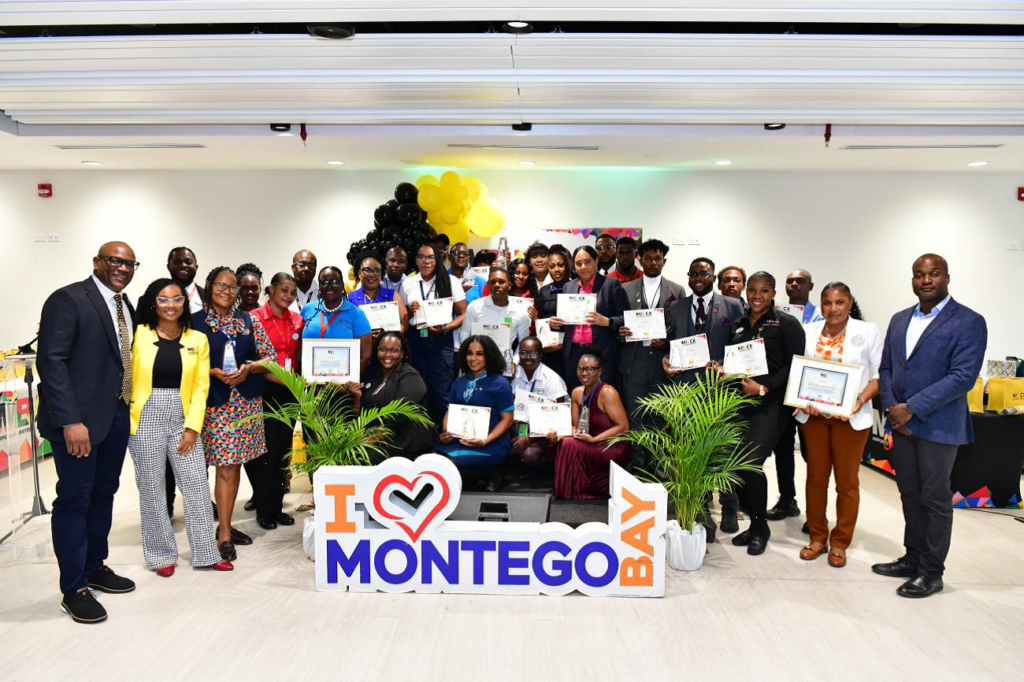
SIA turns the spotlight on its people at Fourth Annual Customer Experience Award
Jamaica Observer
JDDB Supporting Small Dairy Farmers with Shelter Solutions
Jamaica Information Service