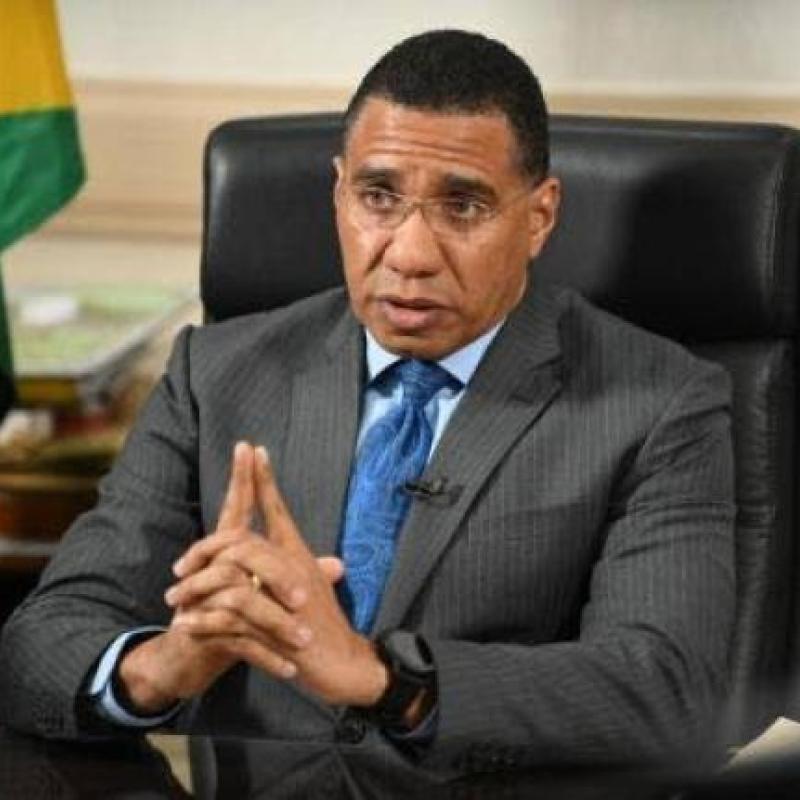
Prime Minister Dr. the Most Honourable Andrew Holness has commended the Jamaica Constabulary Force (JCF) for its continued progress in reducing violent crime and strengthening national security, while reaffirming the Government’s commitment to maintaining the operational superiority of the State over organized criminal networks.
Speaking on Friday (May 22) at the 91st Staff and Junior Command Course graduation ceremony at the National Police College of Jamaica, Prime Minister Holness said the JCF has undergone significant transformation in capability, professionalism, and operational effectiveness, supported by sustained Government investment in training, intelligence, technology, and tactical capacity.
“We have invested heavily in training the JCF. I speak without fear of contradiction that the JCF has the most advanced tactical teams in this region. There is no question about that. I speak with great confidence that gone are the days when any organized criminal entity in the country could take on the JCF and win. That doesn’t exist again. There is no organized criminal entity in Jamaica, or indeed anywhere else in this region, that could take on the JCF and win,” the Prime Minister said.
Prime Minister Holness said Jamaica has asked much of its police officers, including confronting gangs, disrupting transnational criminal networks, removing illegal weapons from communities, restoring public order, and serving vulnerable communities affected by violence and trauma.
He noted that the Force’s growing effectiveness is reflected in continued reductions in murders and other major crimes.
“As at the 19th of May, Jamaica recorded 204 murders to date, compared to 268 over the same period last year. Sixty-four fewer murders, representing a 24 per cent reduction. And this is not just a one-year thing. We are now going into the fourth year. This follows three years of continuous decline, which demonstrates that the strategy is working,” the Prime Minister stated.
Prime Minister Holness attributed the improvements to targeted gang operations, stronger intelligence capabilities, legislative reforms, international partnerships, and the courage of police officers operating in dangerous environments to confront criminal networks.
He further noted that the JCF has made significant strides in rooting out corruption and severing unhealthy relationships that once existed between criminal elements and members of law enforcement.
“The JCF is the first to exclude those persons from membership in your organization. You have separated them from the organization and will continue to do so. That shows the capability of the JCF improving,” he said.
In the meantime, the Prime Minister said the Government is now intensifying efforts to address social violence through a broader national security approach grounded in both enforcement and peacebuilding.
Prime Minister Holness also reiterated the importance of public cooperation with law enforcement, warning that resisting arrest or attempting to evade police only escalates situations unnecessarily.
“The best advice is to comply and then make your complaint afterwards. But it makes no sense to resist the police,” he said.
He stressed, however, that police officers must maintain professionalism in every interaction with citizens and avoid allowing confrontations to become personal.
Prime Minister Holness said changing long-held public perceptions of policing remains a critical part of the JCF’s transformation, noting that increased professionalism, stronger doctrine, and improved public engagement are already contributing to greater respect for the Force across the society.
“The change in your uniform was symbolic, but it is only effective if there is also a change in your mindset… I know that the JCF is investing heavily in changing its doctrine, and we are seeing the impact of this change,” he said.
The Prime Minister pointed to growing public pride in the professionalism of Jamaican police officers, including increasing interest among young people in joining the Force, as evidence that the transformation taking place within the JCF is beginning to reshape public confidence in policing and national security.