
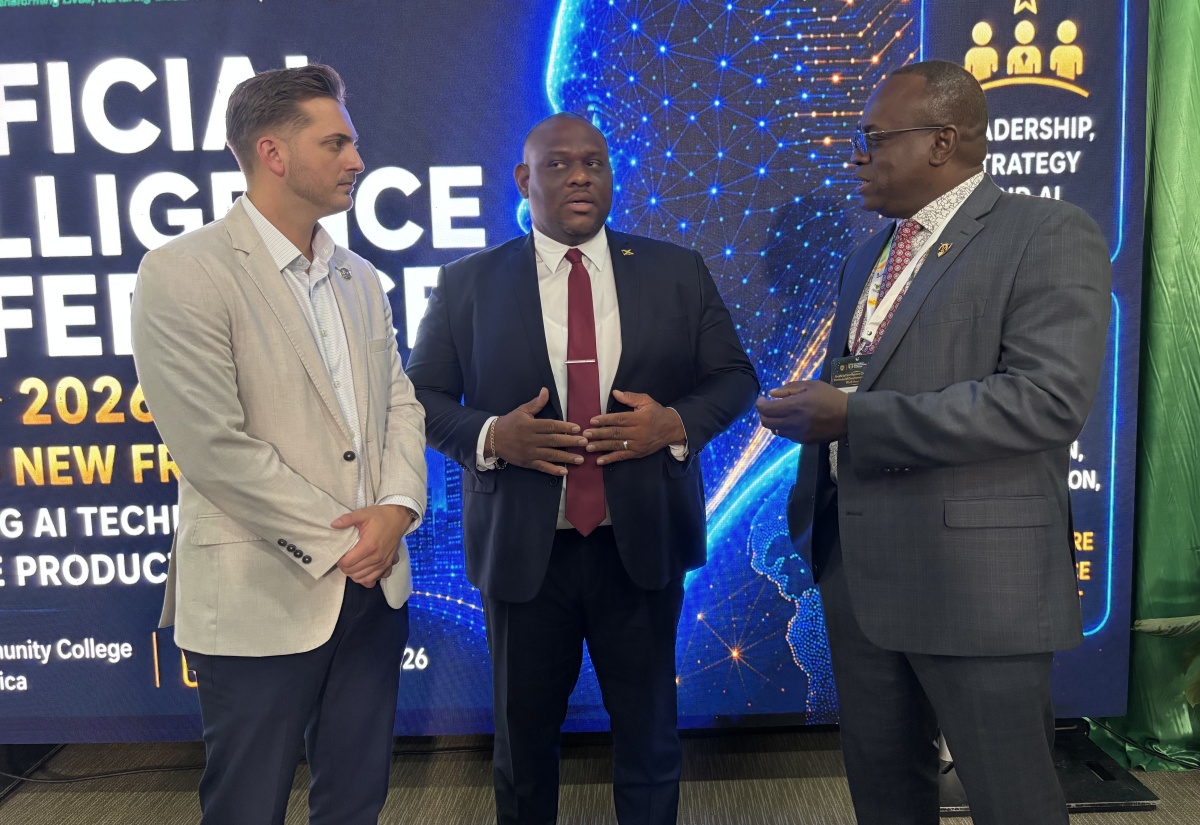
Marlon Morgan urges wider AI literacy as Jamaica pushes responsible technology use
Parliamentary Secretary in the Ministry of Education, Skills, Youth and Information, Senator Marlon Morgan, is calling for stronger national action to make artificial intelligence easier for Jamaicans to understand, trust and use responsibly.
He said the country must help citizens tell the difference between AI systems that support human worth and national progress and those that weaken the wider public interest.
“This is the work of demystification, and it is an urgent proposition because the more our citizens understand AI, the more agency they will have over their own futures. The less they understand it, the more susceptible they become to manipulation, to misinformation, to disinformation, to the concentration of AI’s benefits in the hands of a few,” Senator Morgan said.
He added that education leaders, policymakers, administrators and institutions have a duty to build people’s skills so Jamaicans are not excluded from the gains being created by new technology.
“Our job as educators, as policy makers, as institutional leaders and administrators, is to make sure our people are upscaled. We cannot afford for our people to be left behind. We have to understand and help them to understand AI well enough to use it purposefully and to question it critically… we want to ensure that they know not only what AI can do, but what it should not be allowed to do,” he said.
Senator Morgan made the remarks at the recent opening ceremony for Excelsior Community College’s AI Conference and Professional Development Certification Workshop 2026, staged at the college in Kingston.
His comments were linked to findings from the Public AI Readiness Study Jamaica, released by the Sir Arthur Lewis Institute of Social and Economic Studies at The University of the West Indies, Mona. The study reported that only 60 per cent of respondents said they were interested in receiving AI training.
According to the research, Jamaicans are increasingly aware of AI and are using it more in daily life, but the country still has ground to cover in risk literacy, trust, safeguards and the conditions needed to make the technology’s benefits inclusive, broad-based and useful for development.
The survey also placed public trust in AI at 5.45 out of 10. It found that 81 per cent of respondents strongly backed moderate or strict oversight of AI technologies.
Senator Morgan noted that Jamaica received a score of 60 out of 100 on the Public AI Readiness Index, which placed the country in what the researchers described as “A Developing and Transitioning Category”.
He said the result shows that Jamaica is no longer waiting outside the AI era, but is already participating in it. Jamaicans, he said, are turning to AI in classrooms, workplaces, communication and ordinary daily activities, sometimes without recognising that they are doing so.
However, Senator Morgan cautioned that the advantages of AI are not being shared evenly. The study showed that formal AI training remains limited across the population.
He pointed out that younger Jamaicans, students, tertiary-trained professionals and people in digitally active spaces are moving ahead faster, while groups such as other adults and lower-income households risk falling further behind.
The Parliamentary Secretary also said confidence in AI remains dependent on conditions being met, while public resilience against deepfakes and AI-generated misinformation is still not strong enough.
He argued that Jamaica’s main issue is no longer only whether people can access technology. The wider task, he said, is to expand capability, build trust, improve governance and prevent AI tools from becoming a new way for older inequalities to appear in modern, more advanced forms.
Government, he said, is continuing work to increase the use and application of AI. Approximately $8.2 billion has been committed to upgrade technology in the education sector and to create Jamaica’s first state-of-the-art AI lab at the University of Technology.
Senator Morgan said the lab will give both students and teachers a place to design solutions for schools and for the wider country.
The National AI Task Force, which was established in 2023, completed Jamaica’s National AI Policy recommendations in 2024. Those recommendations are intended to guide ethical and responsible AI adoption across the island.
Syndicated from Jamaica Information Service · originally published .
Legal context · powered by Jurifi
Get the legal angle on this story. Pick a prompt and Jurifi's AI will explain it using Jamaican law.
AI replies are based on Jamaican law via Jurifi. Not legal advice.
Other coverage

BPO leaders reject Opposition’s AI fears
Jamaica Observer
4,000 Textbooks Donated to Schools Affected by Hurricane Melissa
Ministry of Education and Youth
Prime Minister Holness’ National Labour Day Message 2026
Jamaica Observer
Prime Minister Holness’ National Labour Day Message 2026
Office of the Prime Minister
Education Minister Cautions Against Over-Reliance on Tech In The Home
Ministry of Education and Youth