

PIOJ puts Jamaica’s 2025 headcount at 2.76 million after gain of only 600
KINGSTON, Jamaica (AFP) — At the close of 2025 Jamaica’s population stood at an estimated 2,764,200, up from 2,763,600 a year earlier. That equates to a net rise of 600 people and a growth rate of 0.0 per cent, the Planning Institute of Jamaica (PIOJ) reports in the 2025 Economic and Social Survey Jamaica.
The survey recorded 28,900 births and roughly 21,300 deaths during the year, producing a natural increase of 7,600. Emigration offset most of that gain: the island lost an estimated 7,000 people to migration, down from 8,800 the year before.
On the muted expansion, the PIOJ said, “Jamaica is undergoing demographic changes that are consistent with the final stages of the demographic transition model which is characterised by low fertility and low mortality rates; this contributes to low or negative population growth”. “At the same time, demographic shifts are exacerbated by climate-related shocks, which are intensifying vulnerability, as evidenced by the impacts of Hurricane Melissa…,” it added.
The institute also pointed to shifts in the population’s age and sex mix in 2025. A substantial share remains of working age (15–64 years), while the dependent elderly cohort (65 and over) is growing. The proportion of children aged 0–14 keeps shrinking. As the PIOJ put it, “net migration loss, below replacement level fertility rates and population ageing have all had an impact on the population structure”.
Over the longer term, both the crude birth rate and the crude death rate have been falling. Households are getting smaller on average, and more people live alone.
Policy responses to these patterns have continued, tied to national, regional and global agendas such as Vision 2030 Jamaica National Development Plan; the National Population and Sustainable Development Policy and Programme of Action; the National Policy on International Migration and Development; the Montevideo Consensus on Population and Development for Latin America and the Caribbean; and the 2030 Agenda for Sustainable Development. Focus areas have included social protection; awareness of population ageing; fertility below replacement level; health and non-communicable diseases; and education and skills training.
The PIOJ stressed that spending in those fields matters if Jamaica is to harness its still-sizeable working-age population for growth and sustainable development. On international migration, civil registration, and diaspora and development, work has gone on among government bodies, non-governmental organisations and international partners. Among the steps cited were mainstreaming the national international migration and development policy in local projects; drafting the five-year Implementation Plan for the National Diaspora Policy; an update of the national migration database by the Statistical Institute of Jamaica; review of the draft CARICOM Regional Labour Migration Policy Framework and the Global Compact for Safe, Orderly and Regular Migration; and sharing results from research on high-skilled migration covering Jamaica, Belize and Grenada.
Syndicated from Jamaica Observer · originally published .
Legal context · powered by Jurifi
Get the legal angle on this story. Pick a prompt and Jurifi's AI will explain it using Jamaican law.
AI replies are based on Jamaican law via Jurifi. Not legal advice.
Other coverage
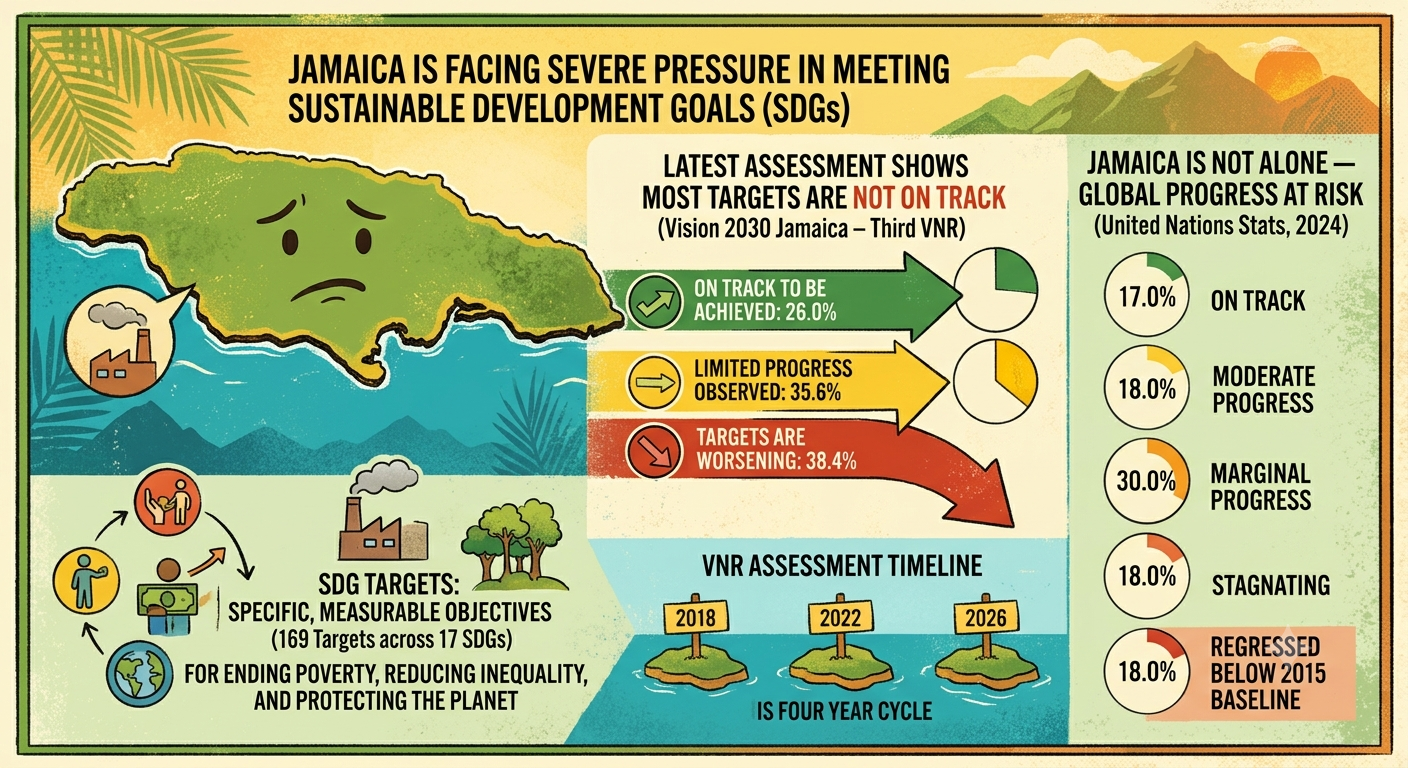
Jamaica failing in most SDG targets like its LAC counterparts
Our Today
Editorial | Strengthening rural development
Jamaica Gleaner
Jamaica Magazine - 06.07.2026
Jamaica Information Service (Video)Watch
Global Services Industry urges national action to safeguard Jamaica’s competitive edge
Our Today
Consolidated Bakeries Jamaica Ltd (PURITY) Annual Report for the year 2025
Jamaica Stock Exchange