
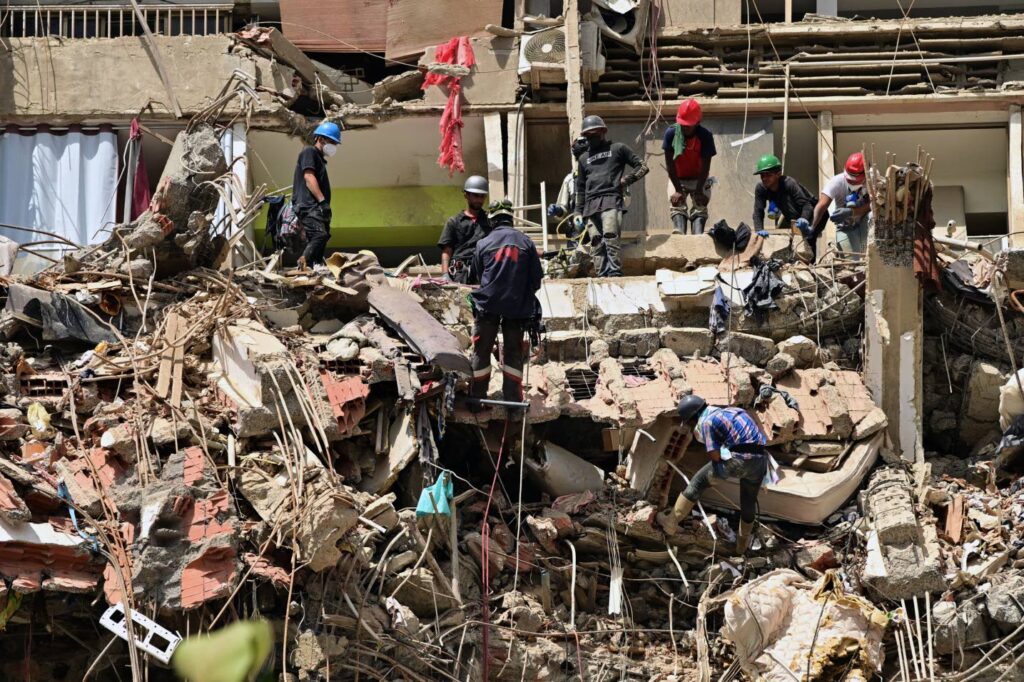
Three-storey family build withstands Venezuela twin quakes as neighbouring towers fall
LA GUAIRA, Venezuela (AFP) — Elias Eduardo Chayeb broke down in tears of relief when he reached the modest apartment block he and his father had put up along the La Guaira waterfront and found it intact amid wreckage left by Venezuela’s twin earthquakes. Raised 20 years ago, the unpretentious three-level seaside building held firm while taller, upmarket residential towers surrounding it were reduced to rubble.
“On my way here, passing all the destruction, when I saw that it was still standing, I thanked God,” said Elias Eduardo, who is 37.
La Guaira, a favoured Caribbean holiday spot with turquoise waters roughly 40 kilometres (25 miles) from Caracas, absorbed the worst of successive magnitude-7.2 and magnitude-7.5 shocks. The Chayeb family’s property houses six flats in Puerto Viejo, close to Caracas’s international airport, which itself sustained damage in the disaster.
Both Elias Eduardo and his father — also named Elias — credit the building’s low profile as decisive in keeping it upright. They likewise point to sound construction materials and footings tailored to La Guaira’s famously shaky ground. Cracks appeared in some walls, yet the foundations held, as did the windows, stairs and structural columns. Crucially, nobody living there was hurt.
“The building passed the test,” the senior Elias said, visibly eased.
Across a career spanning more than 60 years, he declined commissions for high-rise work, arguing that lofty towers were a poor fit for La Guaira’s terrain — a place where a catastrophic 1999 landslide claimed thousands of lives. Seismic danger weighed on him too: in 1967, a quake killed hundreds of people in Caracas.
“Many of the buildings that they asked me to take on, and that I rejected, collapsed,” he told AFP, indicating a coastal hillside once lined with structures exceeding 10 storeys. Those towers failed within seconds when the tremors hit. Occupants often had no time to flee, a pattern pointing to grave design shortcomings.
By contrast, structures built to resist earthquakes are meant to take in as much seismic force as they can. Elias Eduardo maintained that such buildings may fracture under a major shock in order to shed energy, yet they are not supposed to fail wholesale.
According to the United States Geological Survey, the ruptures ran along the San Sebastian fault system that tracks Venezuela’s northern shoreline. The agency cautioned that ground motion could leave steep hillsides more vulnerable to landslides for months or even years afterward.
“That fault is here to stay,” said the elder Chayeb, whose parents emigrated from Syria to Venezuela during World War I. He urged a thorough rewrite of local zoning rules.
Ingrid Palacios, 61, is thankful she, her relatives and fellow tenants came through unhurt inside the Chayebs’ block. Looking out on the devastation enveloping her, she reflected that the La Guaira she remembered “is gone”. Any reconstruction, she said, will consist of “three-storey buildings, little chalets and very small houses”.
Syndicated from Jamaica Observer · originally published .
Legal context · powered by Jurifi
Get the legal angle on this story. Pick a prompt and Jurifi's AI will explain it using Jamaican law.
AI replies are based on Jamaican law via Jurifi. Not legal advice.
Other coverage

Lost my virginity on a double date
Jamaica Star
Mother-in-law caught us in the act
Jamaica Star
‘Awesome.’ ‘Sad.’ ‘Let’s keep democracy going.’ - Americans weigh in on state of a 250-year-old nation
Jamaica Gleaner
Diabetes can’t stop PEP scholar
Jamaica Star
Pain Still Fresh: 2- Years After 3-YO Boy Was Chopped To Death: Man Gets 15 Years | TVJ News
Television Jamaica (Video)Watch