
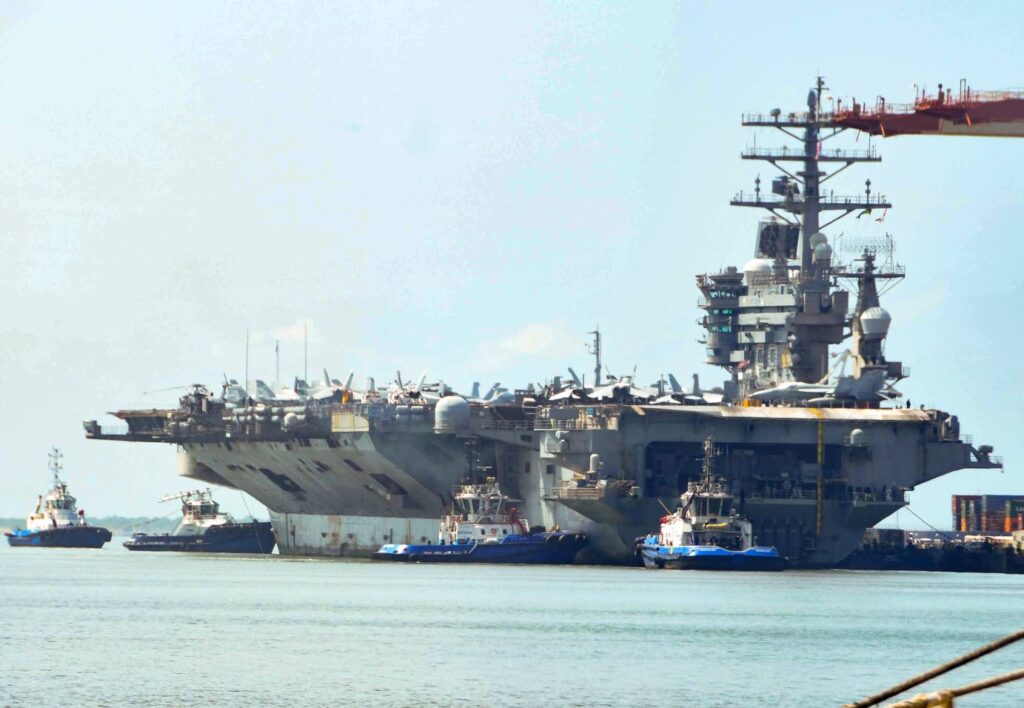
KINGSTON, Jamaica — A tour of the USS Nimitz has sharpened the Spectrum Management Authority’s view of how heavily maritime safety, navigation and national security depend on radio frequency spectrum.
The nuclear-powered aircraft carrier, ranked among the world’s biggest and most technologically advanced, was visited by SMA representatives while berthed at the Kingston Freeport Terminal. The agency said the stop gave its team a close look at communications, surveillance and aviation systems that require stable, protected and interference-free frequencies to support military and maritime work.
The SMA group was headed by Managing Director Dr Maria Myers-Hamilton. Director Kwan Wilson and Compliance Officer Kemar Sutherland were also part of the delegation.
Officials were taken through major operating sections of the carrier and viewed the systems used for communications, navigation, surveillance and aircraft coordination on board.
Myers-Hamilton said the visit made clear how much critical activity relies on spectrum, even when the public may not see that connection.
“Many people associate spectrum with mobile phones, television and internet services, but its role extends far beyond that,” she said. “This visit demonstrated how essential spectrum is to maritime safety, national security, navigation and emergency communications. Whether coordinating aircraft operations, supporting surveillance systems or enabling real-time communications, these technologies depend on reliable access to radio frequencies.
“It reinforced why protecting and properly managing spectrum remains so important, not only for technological advancement but for public safety and national development,” Myers-Hamilton added.
According to the SMA, the visit featured the carrier’s advanced communications equipment, aircraft used for surveillance and terrain mapping, and fighter jets stationed on the ship. The delegation also left with a stronger understanding of the level of coordination needed to run operations on a vessel of that scale.
Colonel Tom Logan of the USS Nimitz said strong communications are central to maritime activity internationally.
“Reliable communications are essential to safe and effective maritime operations. Whether supporting navigation, coordinating vessel movements, responding to emergencies or maintaining operational readiness, these systems depend on secure and interference-free access to radio frequencies. Protecting those frequencies is critical to ensuring safety at sea and the effectiveness of maritime operations,” Logan said.
Myers-Hamilton said the tour helped place the SMA’s mandate in a practical setting, as the authority continues to manage and protect Jamaica’s radio frequency spectrum in line with international standards and best practices.
She said that, with the use of wireless technologies expanding, it remains important to secure key frequency bands used for maritime, aeronautical and public safety communications so services remain dependable and lives are protected.
Myers-Hamilton thanked Colonel Tom Logan and the USS Nimitz crew for hosting the SMA team and allowing officials to observe the technologies and systems supporting one of the world’s most advanced naval vessels.
Syndicated from Jamaica Observer · originally published .
Legal context · powered by Jurifi
Get the legal angle on this story. Pick a prompt and Jurifi's AI will explain it using Jamaican law.
AI replies are based on Jamaican law via Jurifi. Not legal advice.
Other coverage

Maria Myers-Hamilton | Urgent case for road safety in Jamaica
Jamaica Gleaner
Huawei Jamaica’s Cecil Thoms promoted to Director of Communications and Public Affairs
Our Today
The US Navy’s Biggest Warship Will Dock In Jamaica Tomorrow – 90 Miles From Cuba
Jamaica Inquirer
Historic USS Nimitz visit positions Jamaica as a potential global logistics powerhouse
Our Today
Historic USS Nimitz Visit Positions Jamaica As A Potential Global Logistics Powerhouse
Jamaica Information Service