


For too long, Jamaica’s economic imagination has been overly concentrated in Kingston.
If there is a new office tower, we think New Kingston. If there is a major corporate headquarters, we think the Corporate Area. If there is a serious professional opportunity, many young Jamaicans still believe they must move to Kingston, sit in Kingston traffic, pay Kingston rent, and compete inside Kingston’s already pressured economy.
That mindset may have made sense in an earlier Jamaica, when administrative power, finance, government, media, professional services and large corporate institutions were clustered in one place. But it cannot be the organising principle for the next stage of national development.
Jamaica’s next growth story cannot be built by squeezing more people, more cars, more businesses and more ambition into the same few urban corridors. The next phase of development must be built outside Kingston.
This is not an argument against Kingston. Kingston remains the country’s financial, administrative and commercial centre. It is where much of the capital is raised, where policy is shaped, where institutions are headquartered, and where national influence is often concentrated. Kingston will remain important.
But Kingston cannot be the only serious engine of opportunity.
A country cannot call itself ambitious if opportunity is concentrated in one urban centre while the rest of the population is asked to wait for development to trickle outward.
A modern Jamaica must have multiple growth centres. It must have strong parish capitals, stronger secondary towns, more investable communities, and a development model that allows people to build serious lives where they are from. The future must include Spanish Town, Portmore, May Pen, Mandeville, Montego Bay, Ocho Rios, Morant Bay, Linstead, Savanna-la-Mar, Falmouth, Black River and other towns that can become real engines of employment, housing, services and investment.
Kingston’s congestion is a national economic cost
The case for developing outside Kingston is not only emotional or political. It is economic.
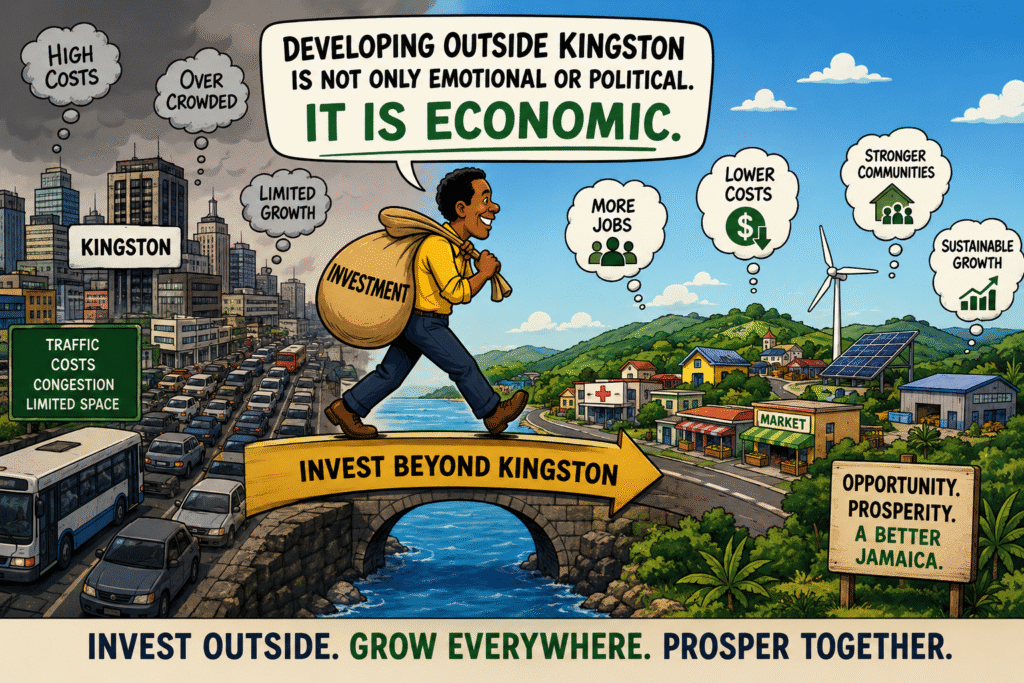
When too much of the country’s opportunity is concentrated in one place, everyone pays for it. Kingston’s traffic steals productive hours from workers and business owners. Housing costs in and around the Corporate Area push young professionals farther from where they work. Commercial space becomes more expensive. Families spend more time commuting and less time building. Small businesses face higher rent, higher staff costs and more operational friction.
At some point, the concentration of activity begins to reduce the very productivity it was supposed to create. Congestion becomes a hidden tax. Long commutes become a tax. Expensive housing becomes a tax. Pressure on schools, roads, hospitals, water, drainage and security becomes a tax. These costs may not always appear neatly in a national budget, but households and businesses feel them every day.
For the average Jamaican, development cannot simply mean another building in an already crowded corridor. Development must mean more time, more access, more affordable options, more work closer to home, and a better quality of life.
If a young professional in St Catherine has to spend hours each day moving to and from Kingston, the economy is losing productive time. If a family in Clarendon has to send its most ambitious young people to Kingston to access opportunity, the parish loses talent. If a business in St Thomas cannot scale because the surrounding infrastructure is too weak, the country loses growth. If every major service remains concentrated in Kingston, national development becomes uneven by design.
That is not sustainable. It is also not necessary.
The bones of a more balanced economy already exist
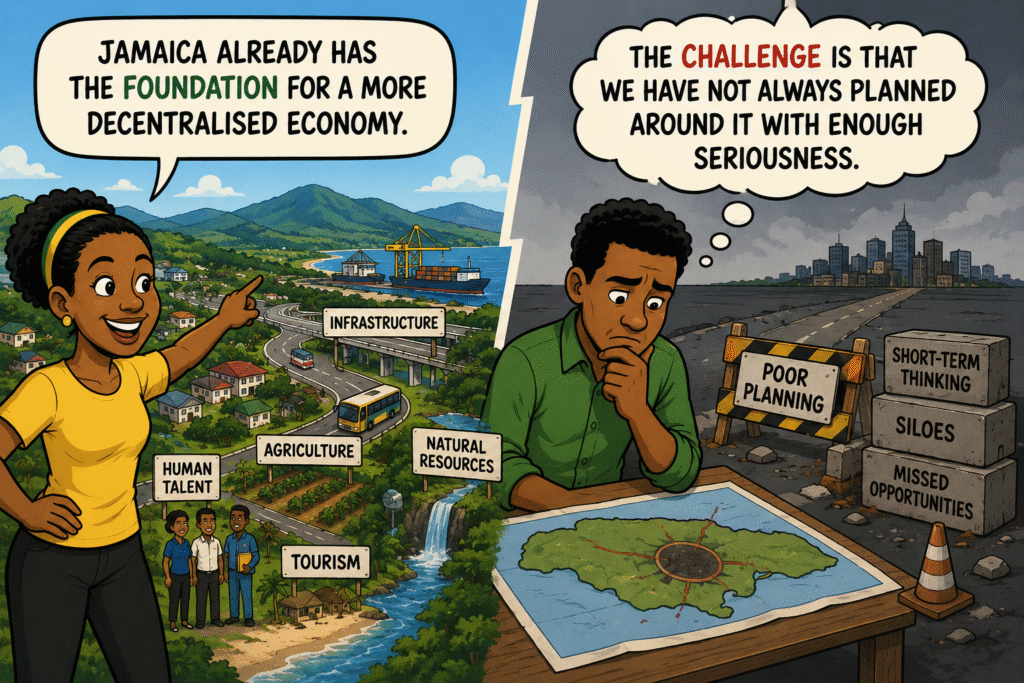
Jamaica already has the foundation for a more decentralised economy. The challenge is that we have not always planned around it with enough seriousness.
Montego Bay is not only a tourism city. It is a business process outsourcing centre, a real estate market, a services hub and one of the most internationally connected urban areas in the country. It has an airport, hotel stock, a growing professional class, and a brand that reaches far beyond Jamaica.
Portmore is not merely a dormitory community for Kingston. It is one of the largest concentrations of consumers, workers and homeowners in the country. It has the population base to support entertainment, retail, healthcare, education, professional services, digital work and stronger commercial districts of its own.
Spanish Town is not simply the old capital. It sits in one of the most strategically important locations in Jamaica. With the right planning, it can support logistics, warehousing, manufacturing, affordable housing, transport-linked commerce and stronger municipal services.
Mandeville has long had the ingredients for a different type of growth story: education, healthcare, retirement living, climate appeal, professional services, residential development and a strong middle-class base. It should be positioned as more than a quiet inland town. It can become one of Jamaica’s strongest lifestyle and services economies.
May Pen has the geography to become a more important central Jamaica commercial hub. It sits between Kingston and the west, with room for agro-processing, distribution, retail, transport services, housing and light industry.
Morant Bay, with new public and private investment, can become the eastern anchor St Thomas has needed for generations. The parish has long carried promise, but promise is not enough. It needs infrastructure, institutions, housing, commerce and confidence.
Ocho Rios, Falmouth, Savanna-la-Mar, Linstead and other town centres each have different opportunities. Some are tied to tourism, some to agriculture, some to logistics, some to housing, some to services. The point is not that every town should become Kingston. That would be the wrong ambition. Each town should become a stronger version of itself.
Development must be built around clusters, not scattered projects
Too often in Jamaica, development is treated as a set of isolated projects. A housing development here. A road upgrade there. A shopping plaza somewhere else. A government office in another location. These projects may be useful, but without a wider economic plan, they do not always create a true growth centre.
The next stage of development must be cluster-based.
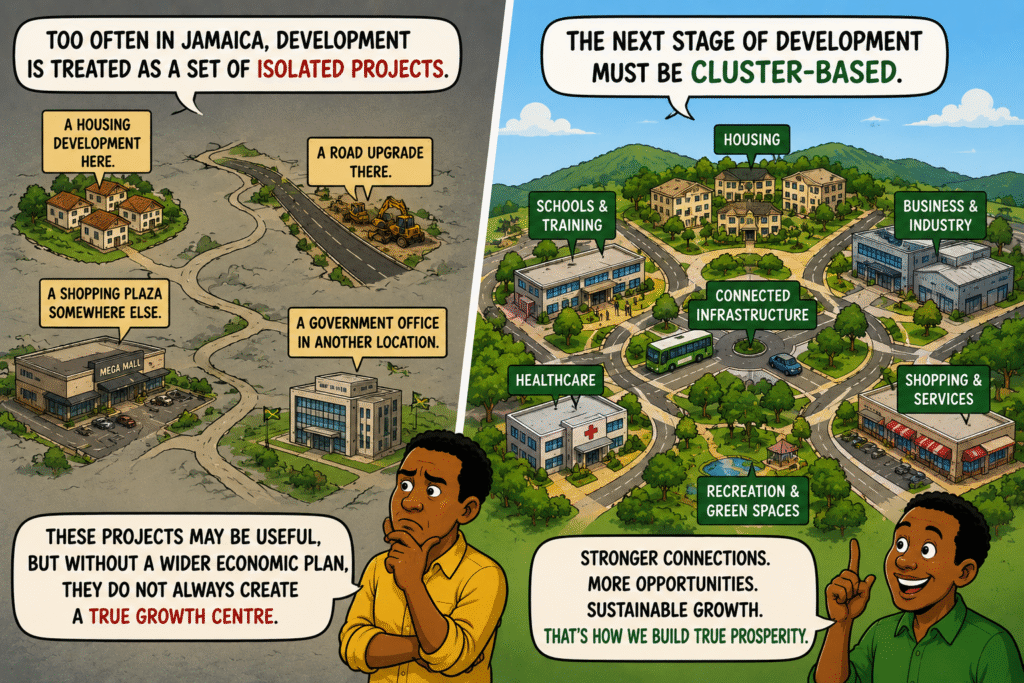
Housing should be connected to employment. Employment should be supported by transport. Transport should be supported by digital infrastructure. Digital infrastructure should be supported by reliable electricity. Commercial development should be supported by schools, healthcare, security, drainage and public spaces. A town becomes investable when these pieces begin to work together.
A housing scheme without jobs simply creates longer commutes. A business park without housing creates labour constraints. A new road without zoning can create disorder. A town centre without parking, pedestrian access and public order can struggle to attract formal investment. A parish capital without strong broadband and reliable electricity cannot become a serious digital services hub.
This is why the country must move beyond symbolic development and toward planned economic ecosystems.
In Spanish Town and Old Harbour, the opportunity may be logistics, warehousing, manufacturing, distribution and affordable housing. In Portmore, it may be services, entertainment, retail, professional offices and digital work. In May Pen, it may be agro-processing, transport-linked commerce and central Jamaica services. In Mandeville, it may be healthcare, education, retirement living and professional services. In Morant Bay, it may be government services, commercial activity, agriculture-linked businesses and eastern parish renewal. In Montego Bay, it may be the next stage of tourism, outsourcing, real estate and regional business services.
These are not small ambitions. They are the building blocks of a more productive Jamaica.
The private sector has to move earlier
Government has an important role to play. It must provide infrastructure, planning approvals, zoning discipline, public order, basic services and long-term policy direction. But government alone cannot build the next generation of Jamaican towns. Private capital has to move earlier and more confidently.
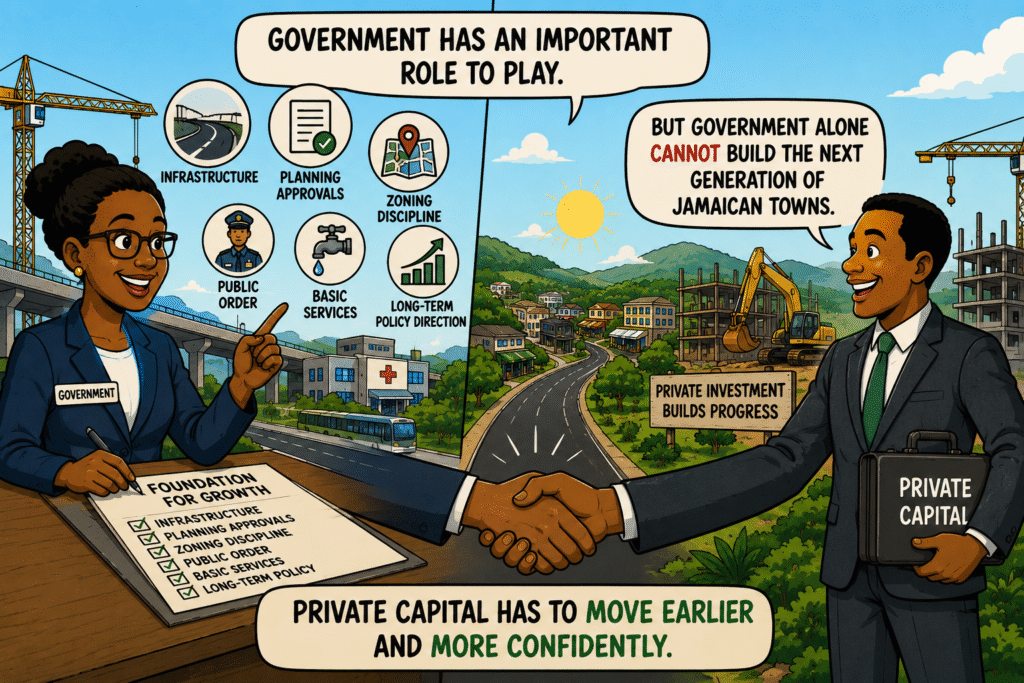
Banks, pension funds, credit unions, insurance companies, developers, family offices and private investors should be looking at secondary-town development as one of Jamaica’s most important investment frontiers.
There is a strong commercial argument for this. Land is often more affordable outside Kingston. Consumer demand is growing in many parish towns. Younger families are increasingly priced out of the Corporate Area. Remote and hybrid work have changed the geography of professional employment. Businesses are searching for lower-cost operating locations. Healthcare demand is national. Education demand is national. Logistics demand is national. Entertainment demand is national.
The private sector should not wait until every area is fully developed before it enters. By then, the early returns are gone. The real opportunity is often in being early: acquiring land, building commercial space, financing housing, opening branches, supporting entrepreneurs, backing local services and helping create the market before it becomes obvious to everyone else.
Investors should be asking a new set of questions. Where will Jamaica’s next middle-class communities emerge? Which parish towns are underserved by healthcare, education, entertainment, warehousing and professional services? Where can small manufacturers operate at a lower cost? Where can outsourcing expand next? Where can agro-processing facilities sit closer to farmers? Where can housing be paired with real employment?
Those questions will shape the next decade of Jamaican investment.
The household impact is just as important as the investment case
It is easy to discuss development in the language of policy, capital and infrastructure. But the real test is what it does for the average household.
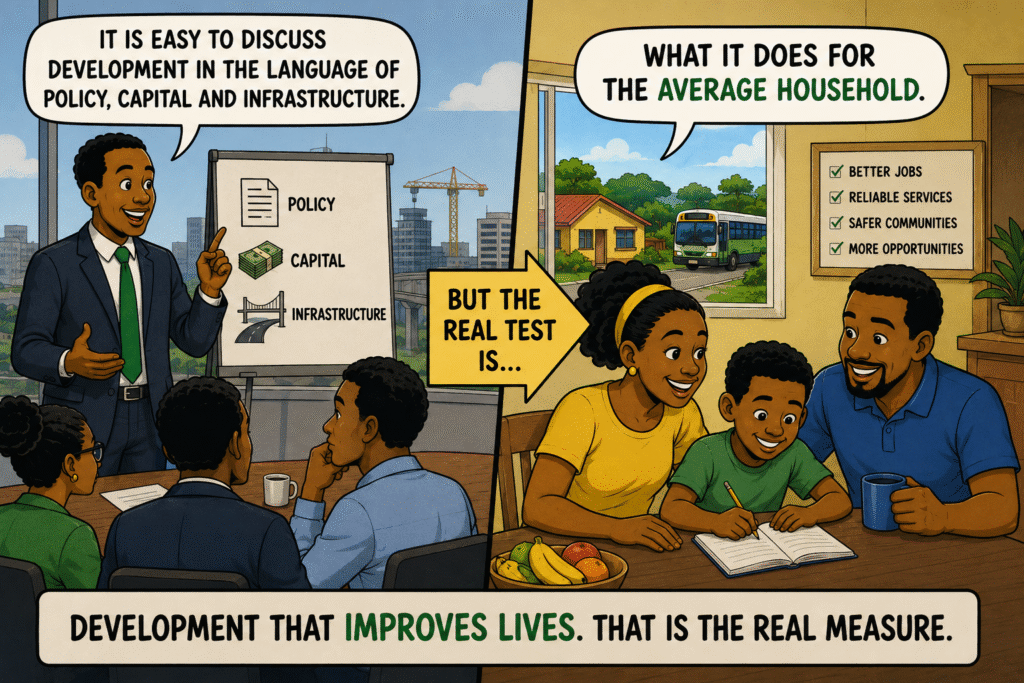
A more balanced Jamaica means a young person from Clarendon may not have to leave home to find a decent job. It means a small business in St Thomas may get more foot traffic and commercial activity. It means a nurse in Manchester may have access to stronger facilities and better housing options. It means a family in St Catherine may spend less time commuting and more time together. It means a professional in St Ann or St James may not have to choose between career growth and quality of life.
Development should not force everyone into the same few spaces. It should expand the number of places where a good life is possible.
That is why this issue is not only about construction. It is about dignity. It is about whether a Jamaican can look at the community they came from and see a future there. It is about whether ambition requires migration. It is about whether opportunity is something people must chase into Kingston, or something the country can build closer to them.
The deepest frustration in many communities is not a lack of talent. It is the feeling that opportunity is always somewhere else.
When people believe they must leave to succeed, communities lose their strongest builders. Teachers, nurses, entrepreneurs, accountants, engineers, tradespeople, creatives and young professionals all carry human capital. If every pathway points to Kingston, then too many towns become places of departure rather than places of growth.
A national growth map is needed
Jamaica should approach the next decade with a clear national growth map. This does not need to be a complicated document that sits on a shelf. It should be a practical investment framework that identifies the economic role of major town centres and aligns infrastructure, housing, transport, public services and private investment around those roles.

For example, if a town is to become a logistics hub, then road access, industrial land, warehousing, customs support, security, broadband and worker housing must be part of the plan. If a town is to become a healthcare and retirement hub, then medical facilities, residential communities, emergency services, pharmacies, insurance linkages and senior-friendly infrastructure must be coordinated. If a town is to become a digital services hub, then broadband, power reliability, training institutions, commercial space and transport must be in place.
This kind of planning also helps investors. Capital moves more confidently when it can see where the country is going. Developers, lenders and businesses are more likely to commit when infrastructure and policy direction are aligned. Towns need more than ambition. They need a credible investment story.
The country also needs better local execution. Municipal corporations must be strengthened. Planning approvals must become more predictable. Town centres must be made orderly. Public spaces must be maintained. Informal activity must be better organised, not simply ignored. Local government must be treated as a development partner, not an administrative afterthought.
This is how Jamaica reduces pressure on Kingston
The best way to reduce pressure on Kingston is not to complain about Kingston. It is to make other places more competitive.
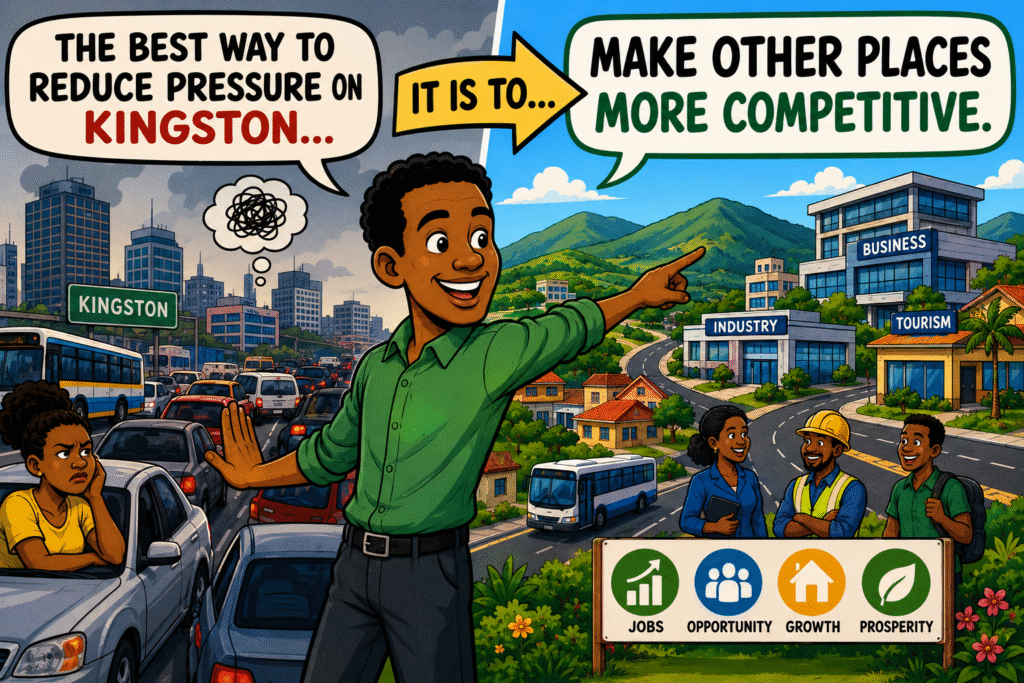
If Portmore has stronger commercial centres, fewer residents need to cross into Kingston for every service. If Spanish Town has more jobs, more people can work where they live. If May Pen and Mandeville attract more investment, central Jamaica becomes stronger. If Morant Bay becomes a serious eastern hub, St Thomas gains economic weight. If Montego Bay continues to deepen beyond tourism, western Jamaica becomes a more diversified growth pole.
This is what a mature development model looks like. It does not depend on one dominant centre. It creates several engines that can support different types of economic activity.
The benefit is national. Kingston becomes less congested. Families get more choices. Businesses get more location options. Land markets become less distorted. Infrastructure pressure is spread more evenly. Young people see more pathways. Investors get more opportunities. Communities retain more talent.
That is how development becomes more inclusive without becoming merely rhetorical.
The Jamaica we should be building
Jamaica does not suffer from a shortage of potential. It suffers from the uneven distribution of opportunity.
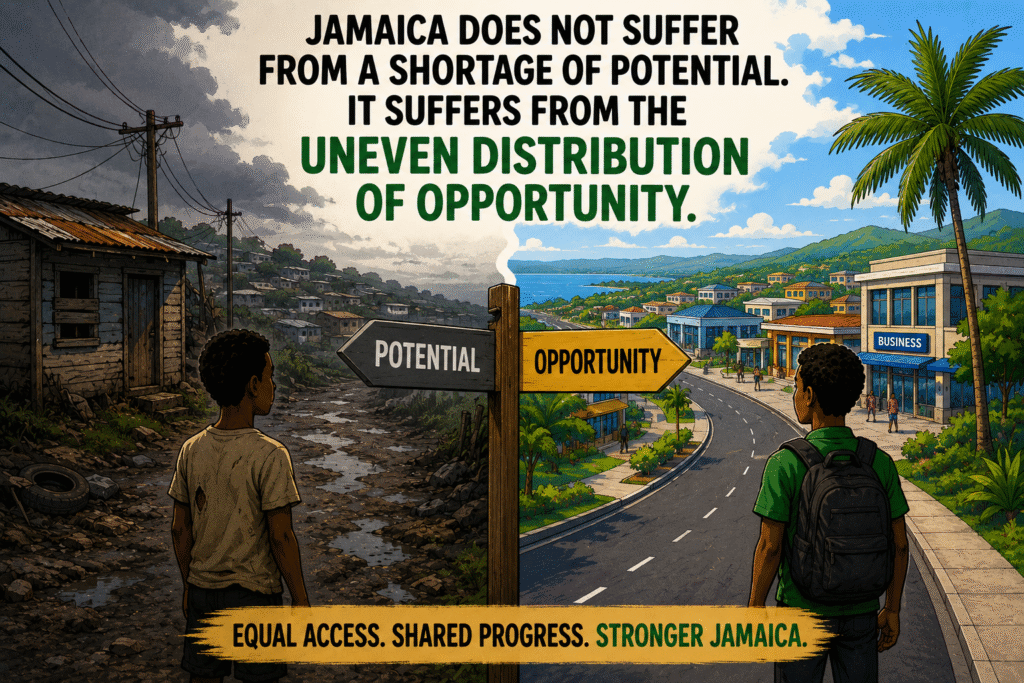
There is talent in every parish. There are entrepreneurs in every town. There are young people with ambition in every community. There are families willing to work, save, invest and build. But too often, the infrastructure of opportunity does not meet them where they are.
The next growth story must change that.
It must be national, not Kingston-centric. It must be practical, not sentimental. It must be investable, not only aspirational. It must connect roads to jobs, housing to services, capital to communities, and planning to real execution.
Kingston has played its role. It will continue to play its role. But it should not be asked to carry the entire ambition of the country.
The next generation of Jamaican growth should not only be measured by what happens in New Kingston, Half-Way Tree or the waterfront. It should be measured by what happens in Spanish Town, Portmore, May Pen, Mandeville, Morant Bay, Montego Bay, Ocho Rios, Linstead, Savanna-la-Mar and every other town where Jamaicans are waiting for development to finally meet them where they are.
That is the Jamaica we should be building.
Not one city of opportunity surrounded by communities of frustration.
But a country of many engines, many centres and many futures.
Ambraee Houslin is a private equity strategist with experience in investment analysis, corporate finance, transaction structuring and strategic advisory across the Caribbean. His work focuses on capital formation, business growth, private markets, infrastructure-led development and the role of investment in expanding opportunity across Jamaica and the wider region.
Syndicated from Our Today · originally published .
Legal context · powered by Jurifi
Get the legal angle on this story. Pick a prompt and Jurifi's AI will explain it using Jamaican law.
AI replies are based on Jamaican law via Jurifi. Not legal advice.
Other coverage
Dean Jones | Is there still a real estate boom in Jamaica today?
Jamaica Gleaner
Official Groundbreaking Ceremony for the Wick Hall Estate || June 12, 2026
PBC Jamaica (Video)Watch
JISTV | PM Keynote Address at the Official Groundbreaking Ceremony for Wick Hall, Featherbed Lane
Jamaica Information Service (Video)Watch
Keynote Address at the Official Groundbreaking Ceremony for Wick Hall, Featherbed Lane
Andrew Holness (Video)Watch
‘Don’t make it permanent’ cautions Tavares-Finson while backing Govt’s decision to withdraw funds from NHT
Jamaica Observer