
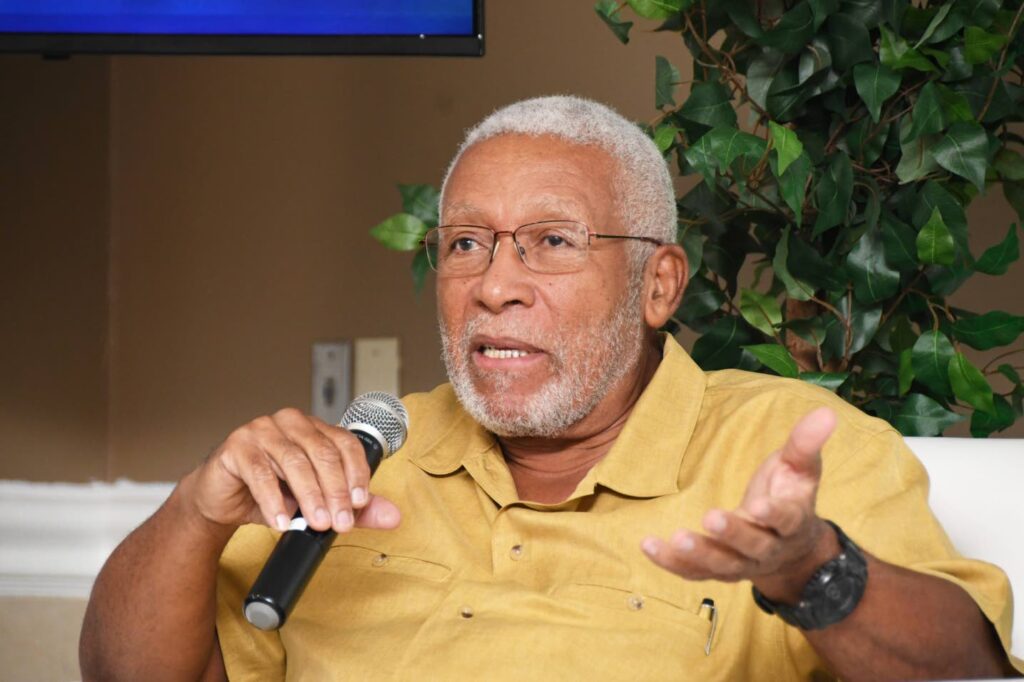
Hardley Lewin criticises slow body camera rollout for JCF operations
Former Commissioner of Police Rear Admiral Hardley Lewin has rejected the explanations being offered by the Government and senior Jamaica Constabulary Force (JCF) officials for why body-worn cameras are still not standard on planned police operations.
Lewin made the comments on Wednesday at a Jamaicans for Justice policy roundtable on the use of body-worn cameras by law enforcement in Jamaica. The session was held at the Courtleigh Hotel in New Kingston.
The former head of both the JCF and the Jamaica Defence Force was answering moderator George Davis, who asked about the Government’s $2-billion investment to strengthen the police’s crime-fighting capacity, including the purchase of body cameras.
Lewin said he has consistently credited the Administration for what he called the “big spend on national security”, saying that level of funding has helped to modernise the JCF. However, he argued that the most significant advance for policing in Jamaica since motor vehicles became part of police work has been closed-circuit television, including the JamaicaEye network of public-space cameras.
He said the authorities should have expanded that programme with far greater urgency, instead of putting heavier emphasis on other areas of policing.
“The first job of the police is not to fight crime; it’s to prevent the crime. So this notion that we’re out there fighting crime, after the crime has been committed, it’s a failure of policing. And, we use cleared-up rate as our effectiveness [but] it’s [our ability] to prevent the crime [that measures that effectiveness — and] CCTV is critical to that deterrence,” Lewin said.
Deputy Commissioner of Police Warren Clarke had earlier told the JFJ roundtable that thousands of additional body-worn cameras are to be bought up to 2029, at substantial cost. Lewin, however, said the timetable is not ambitious enough.
He said cameras are most urgently needed in planned special operations, where public scrutiny is often weakest and the risk of deadly confrontation is high. Lewin argued that the priority should not be ordinary patrols, such as officers walking through market areas, but operations where the police are moving into high-risk situations.
“In this critical area where we need to shine some light in that dark corner of those particular planned special operations… cameras must be employed, — not [given to] the man [policeman] walking the market streets and so on…” he said.
Lewin said the reasons given for the limited pace of deployment have shifted over time. Among the explanations, he said, were claims that the devices could not operate in stealth mode and that some uniforms could not properly carry them.
“None of these things [make sense] so you keep moving the goalpost. To what end? They take us for fools,” Lewin said.
He also defended the Independent Commission of Investigations (Indecom), which has repeatedly urged that body cameras be used during all police operations, particularly those in which officers are expected to encounter armed suspects.
Indecom has maintained that cameras would improve transparency and accountability, especially in cases where witness accounts conflict with police reports. The commission has intensified that call as fatal shootings by the police have risen sharply.
Lewin said Indecom is placed in an almost impossible position when the only account available comes from several police officers who all give the same version of events.
“What the hell is Indecom going to do in such cases where you have an ironclad statement from four or five police officers that this is what happened?” he asked.
“They’re not denying that they shoot the man; what’s Indecom going to do? Their hands are tied behind their backs!” Lewin argued.
He said that, without independent evidence, investigators may be left with a dead suspect, no witnesses at the scene, and police statements that cannot easily be tested. In those circumstances, he said, Indecom is being asked to reach conclusions it cannot fairly reach.
Lewin said the lack of video evidence is also unfair to members of the JCF who use lethal force lawfully. In some cases, he argued, officers may have acted properly under the force’s use-of-force policy, but Indecom still cannot make a firm finding that the shooting was justified.
“They’re also tarred and feathered when in fact they acted in accordance with their use of force policy. It is not fair to them,” he said.
Lewin said his concern is not the number of people killed by the police, but whether each death can be independently shown to be lawful. He said he would not object even if 1,000 people were shot and killed by the police, provided there was verifiable proof that each shooting was justified.
“It’s not the numbers; it’s the principle, the transparency and the accountability,” he said.
According to Lewin, the reluctance to obtain and properly use body-worn cameras during planned operations points to what he described as a troubling motive.
He also quoted at length from an article he wrote for the Jamaica Observer, published on June 22, 2025, under the headline, “Those police fatal shootings”. In that article, he warned that the longer Jamaica takes to address gaps in transparency and accountability, the more room the police are given to continue without adequate scrutiny.
“The longer we take to close the transparency and accountability gap, the longer the runway we give the police to run with it, so delay, delay, delay. Let us see how far down the runway we can get before our international partners and other groups become antsy and start demanding answers. This has happened before,” Lewin quoted from the article.
He acknowledged that many Jamaicans, worn down by violent crime and especially murders, may support a tough approach if they believe it produces results. Still, he said the country must decide whether it wants to be governed by laws that apply evenly to everyone, or whether it is prepared to violate its own rules in the name of public protection.
Addressing members of the JCF, Lewin said the force is larger and better equipped than at any previous point in its history. He said officers now have more resources, more tools, and more well-trained personnel, including both gazetted officers and rank-and-file members.
“You do not have to resort to any form of quick fixes — howsoever popular and seemingly effective — if it violates the laws you are sworn to uphold,” he said.
Lewin urged police personnel to remain within the law, even when dealing with criminals who do not. He warned that officers who operate outside the rules risk becoming criminals themselves, and that public supporters may disappear quickly if things go wrong.
“Remember, those who glorify and worship you today will be amongst the first to abandon you to save their skins when things go wrong,” Lewin said.
Syndicated from Jamaica Observer · originally published .
Legal context · powered by Jurifi
Get the legal angle on this story. Pick a prompt and Jurifi's AI will explain it using Jamaican law.
AI replies are based on Jamaican law via Jurifi. Not legal advice.
Other coverage

Civilians Vs. Body-Worn Cameras | TVJ Smile Jamaica
Television Jamaica (Video)Watch
10 Injured in St. Mary Crashes | Commish calls for restraint | Man knocks out teeth/JBNN
JBN Network (Video)Watch
CVM News at 7 PM | @CVMTVNews
CVM TV News (Video)Watch
Deportee among two cut down by police | Stolen items recovered in Manchester | Manchester JP charged
JBN Network (Video)Watch
Force4Good Podcast: Season 2: EP 2 - Inside the Strategic Operations Portfolio
JCF — Jamaica Constabulary Force (Video)Watch